

7 Power Cables for High-Output LED Monolights That Perform
Last Updated: November 12, 2026
Quick Summary
The best power cables for high output LED monolights are rated for the fixture's actual current draw, not just the plug fit. A 2400B-class monolight draws about 20 amps at 120 volts, so choose 12-gauge copper as the practical minimum and stay under Nanlux's 20-meter total DC limit.
- A 2400B-class monolight rated at 2400 watts draws about 20 amps at 120 volts and about 10 amps at 240 volts.
- 12-gauge copper is the sensible floor for heavy AC runs, with 10-gauge for long or high-current paths.
- Nanlux caps total connected DC cable length for the Evoke 2400B at 20 meters.
- The 12M DC Connection Cable for the Evoke 2400B costs $649.00 and has a silicone outer jacket.
- Confirm the fixture model, connector type at both ends, maximum coupled length, and continuous current rating before ordering.
Table of Contents
- What High-Output LED Monolights Demand From a Power Cable
- Why a Household Extension Cord Fails a 2400B
- Power Cable Amp Rating: Matching the Cable to the Load
- Extension Cord Wire Gauge: What Gauge Do You Actually Need?
- LED Light Cable Length and Voltage Drop: What Happens Over 12 Meters
- The Nanlux DC Cable Line for the Evoke 2400B and Evoke Series
- Lighting Power Cable Inspection: A Pre-Shoot Checklist
- Connector and Inlet Compatibility Before You Buy
- Ordering the Right Cable for Your Next Shoot
- Frequently Asked Questions
What High-Output LED Monolights Demand From a Power Cable
The best power cables for high output LED monolights are the ones rated for the fixture's actual current draw, not the ones that happen to fit the plug.
High-output LED monolights are not like the LED strip kits most wiring guides describe. They are professional fixtures with a separate power supply, a heavy DC cable running to the head, and continuous-duty demands that run for hours at a time. Get the cable wrong and you get heat, voltage drop, flicker, or a dead fixture mid-take.
Why a Household Extension Cord Fails a 2400B
A household extension cord fails a high-output monolight because it is built for intermittent loads, not continuous professional draw. The typical 16-gauge cord sold for home use is rated for a fraction of the current a studio fixture pulls, and the thin conductors heat up under sustained load.
Three things go wrong, in order:
- Conductor heat. Thin copper wire resists current flow. Under a heavy continuous load, that resistance turns into heat inside the jacket.
- Voltage drop. The longer and thinner the run, the more voltage is lost before it reaches the fixture. The light dims and the power supply works harder.
- Connector failure. Household plugs and inlets are not designed for the vibration and repeated connect/disconnect cycles of a shooting day.
Watch out: using a hardware-store cord to reach a fixture across a warehouse floor may work briefly, but the jacket can get warm and the fixture may start to misbehave.
Power Cable Amp Rating: Matching the Cable to the Load
Power cable amp rating is the maximum current a cable can carry continuously without overheating, and it must exceed your fixture's draw with margin to spare.
Start with the fixture's rated wattage, then convert to current at your supply voltage using current equals watts divided by volts.
A common pattern is to size the cable from the fixture's wattage but forget that the cable rating and the circuit-breaker rating are two different limits. The breaker protects the branch circuit and is sized to the wiring in the wall; the cable you add is a separate component with its own ampacity, and a 12-gauge cord does not make a 15-amp circuit safe for a 20-amp load. If the fixture's draw approaches the breaker rating, the correct move is a dedicated circuit or a qualified electrician, not a thicker cord.
Duty cycle matters as much as the headline number. A monolight running for hours at a time generates more sustained heat than a fixture used in short bursts, so leave headroom between the continuous draw and the cable's rating.
Extension Cord Wire Gauge: What Gauge Do You Actually Need?
Extension cord wire gauge is the thickness of the copper conductors inside the cable, expressed as an AWG number where a lower number means thicker wire. For high-output studio fixtures, thicker is safer: 12-gauge copper is the sensible floor for heavy AC runs, with 10-gauge for long or high-current paths.
Here is how the common gauges stack up for production work:
| Gauge | Typical Use | Load Behavior | Our Take |
|---|---|---|---|
| 16 AWG | Household lamps, small accessories | Heats quickly under heavy draw | Skip for monolights |
| 14 AWG | Light-duty AC runs, short distances | Workable for small fixtures only | Marginal for studio heads |
| 12 AWG | Heavy-duty AC distribution | Handles sustained professional loads | The practical minimum |
| 10 AWG | Long runs, high-current fixtures | Best headroom, least voltage drop | Our pick for long paths |
A heavy-duty 12/3 SJOOW cable, the kind built for film and TV power distribution, gives you the flexible jacket and conductor size that studio work demands. If you need a production-grade run rather than a general-purpose cord, you can shop the 12/3 SJOOW production extension cable we stock for exactly this job.
Reading the Gauge Marking on the Jacket
The gauge marking is printed directly on the cable jacket, usually as a number followed by "AWG" alongside the conductor count, so "12/3" means three 12-gauge conductors. Read it before you plug anything in.
What most guides miss is that the jacket marking also tells you the cable's temperature rating and jacket type. A cable marked for a higher temperature handles sustained load better than a bargain cord with no legible marking at all. If the print has worn off, treat the cable as unknown and pull it from the kit.
LED Light Cable Length and Voltage Drop: What Happens Over 12 Meters
LED light cable length voltage drop is the loss of voltage along a cable run, and it grows with both distance and current.
The DC side is where this bites hardest. Low-voltage DC cable carrying high current loses voltage quickly over distance, because the current is high relative to the voltage. That is why manufacturers cap the total coupled length of their DC extension runs rather than letting crews chain cables indefinitely.
Nanlux sets a clear ceiling for the Evoke 2400B: total connected DC cable length should not exceed 20 meters. Beyond that, power loss and instability become real risks, and no amount of good intentions fixes the physics.
The Nanlux DC Cable Line for the Evoke 2400B and Evoke Series
Nanlux offers a dedicated DC cable line for the Evoke 2400B, and matching the cable to the fixture helps ensure reliable operation. These are proprietary-connector cables, not generic DC cords.
The range covers short, long, and joined runs:
- 1M DC Connection Cable, $159.00. The short factory-length cable for tight studio setups where the power supply sits beside the stand. Secure fit, minimal slack.
- 12M DC Connection Cable, $649.00. The long run, with a silicone outer jacket resistant to pulling, bending, and aging, plus heat-resistant inner wires for the 2400B's current. This is the cable that lets you put the head where the shot needs it.
- DC Extension Cable Coupler for Evoke 2400B, $119.00. An IP65-rated weatherproof coupler in aluminum alloy, silicone, and stainless steel, for joining DC cables. Remember the 20-meter total ceiling.
- DC Extension Cable Coupler for Evoke 1200/1200B/900C, $49.00. The same IP65 coupling approach for the smaller Evoke fixtures, so a mixed kit stays compatible.
You can view the 1M DC connection cable for the Evoke 2400B, check the 12M DC connection cable, pick up the 2400B coupler, or get the coupler for the 1200/1200B/900C depending on what is in your case.
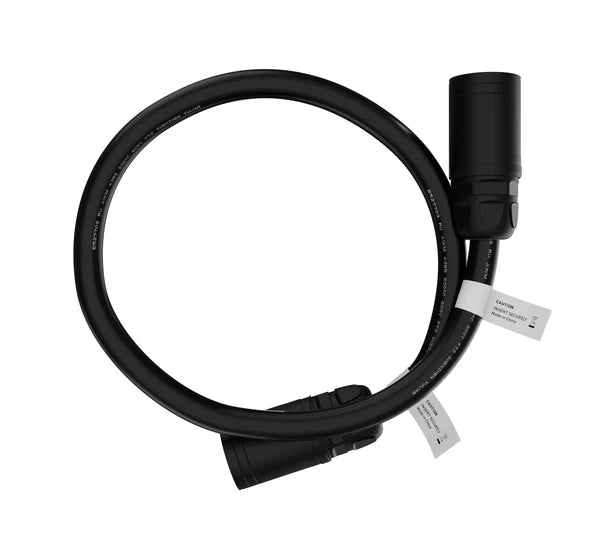
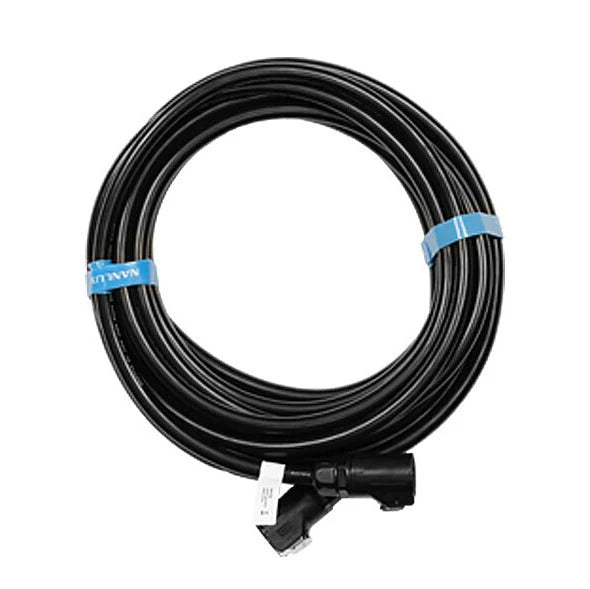
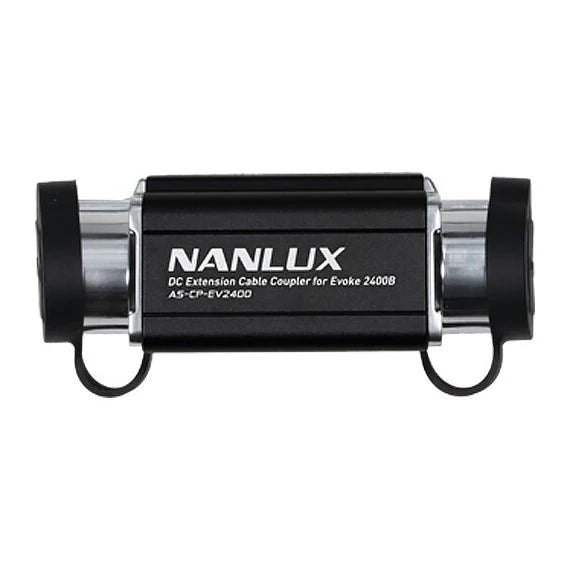
1M, 12M, and Couplers: Which Length Fits Your Set
Choose the 1M for studio work where the supply sits at the base of the stand, the 12M when the head has to travel, and a coupler when you need to join runs you already own. The fixture's 20-meter total limit decides how far you can go.
Best for: the 12M if you routinely place lights across a large stage or location. Skip if: your sets are tight and the supply is always within arm's reach, where the 1M keeps the cable path clean.
One more cable belongs in the conversation: the 8M Connection Cable for the 6 Pin Wired Controller, $89.00. It is not a power cable, but it is the control link for the Evoke and Dyno series, and crews who run wired control need it in the same case.
Nanlux DC cable and coupler prices for the Evoke 2400B
Lighting Power Cable Inspection: A Pre-Shoot Checklist
Lighting power cable inspection is a two-minute routine that prevents most on-set power failures, and it belongs in your call sheet alongside the battery check. Run it before every shoot day.
- Read the jacket marking and confirm the gauge suits the fixture
- Run a hand along the full length, feeling for soft spots, kinks, or exposed conductor
- Check both connectors for bent pins, cracks, or loose fit
- Confirm the cable's rating covers the fixture's continuous draw
- Verify total run length stays under the manufacturer's limit
- Test the full chain, supply to head, before the first setup
- Coil loose, not tight, and store away from heat and sharp edges
A connector that wiggles is a connector that can arc.
Connector and Inlet Compatibility Before You Buy
Connector and inlet compatibility decides whether a cable works at all, and proprietary DC connectors mean you cannot substitute a generic cord.
On the AC side, studio monolights commonly use an IEC-style inlet on the power supply, a grounded three-prong plug, and sometimes a locking connector that twists to seat.
Grounding is not optional.
Before you order, confirm four things: the fixture model the cable lists as compatible, the connector type at both ends, the maximum coupled length the manufacturer allows, and whether the cable is rated for the fixture's continuous current. A coupler built for the 1200/1200B/900C will not serve a 2400B, and the reverse is just as true. When in doubt, compare the connector on the cable you are replacing with the one on the fixture rather than relying on a product photo.
Checking compatibility before you order helps avoid a cable arriving on set that does not fit.
Ordering the Right Cable for Your Next Shoot
Ordering the right cable comes down to four facts: your fixture model, its current draw, the run length you need, and the connector it takes. Get those right and the cable disappears into the background where it belongs.
A practical approach is to buy the factory cable for your fixture first, add a coupler only when you genuinely need the reach, and keep the total run under the manufacturer's ceiling.
Power problems on set almost always trace back to a cable that was never rated for the job.
Frequently Asked Questions
What type of power cable does a high-output LED monolight need?
A high-output LED monolight needs a cable rated for its specific current draw, not a general-purpose household cord. For fixtures like the Nanlux Evoke 2400B, that means the proprietary DC connection cable designed for the fixture, such as the Nanlux 1M or 12M DC Connection Cable. These cables use proprietary connectors designed for the fixture. Using an unmatched cable risks power loss, overheating, and unreliable connections on set.
How do I choose an extension cord for a high-wattage LED light?
Start with the light's wattage and convert it to amps at your supply voltage, then pick an extension cord whose wire gauge and amp rating exceed that figure with headroom. Shorter runs tolerate lighter gauge; longer runs need heavier gauge to limit voltage drop. For a 2400W-class fixture, a household 16-gauge cord is not adequate. Check the jacket marking for the gauge and confirm the cord's amp rating covers the load before you plug in.
Does a longer power cable affect an LED light's performance?
Yes. Longer cable runs increase resistance, which produces voltage drop and can cause dimming, flicker, or the light failing to reach full output. The Nanlux DC Extension Cable Coupler for the Evoke 2400B specifies a maximum coupled cable length of 20 meters for exactly this reason. Stay within the manufacturer's stated limit and use the correct gauge so the fixture receives stable power across the full run.
When should a damaged lighting power cable be replaced?
Replace a lighting power cable immediately if you see exposed conductor, cracked or melted insulation, a bent or corroded connector pin, or a jacket that stays deformed after bending. Also replace any cable that has been pulled hard at the connector or run over by a cart. A pre-shoot inspection catches these before they cause a failure mid-take. Carrying a spare cable, such as the Nanlux 1M DC Connection Cable, keeps a shoot moving if one fails.
